2963. Good Partitions
Count the Number of Good Partitions
Straight to the point: this task is to split the input array into one or more contiguous subarrays,
with the constraint that no two subarrays share the same number. This is called a good partition.
The expected returned value is total number of good partitions.
Can't Join Two Groups? So...
Put it this way: for any number, find its first and last occurrence at indices and .
Both and must belong to the same group.
Which means we need to track the last occurrence index of each number.
With that in hand, we launch two pointers: scanIdx and boundaryIdx.
boundaryIdx represents the right boundary index of the current unfinished group .
scanIdx is used to incrementally scan indices within that haven't been checked yet.
What are we checking? Whether the last occurrence index of the number at scanIdx exceeds boundaryIdx.
If it does, we must update boundaryIdx = ,
so that stays loyal and remains within the current unfinished group , ensuring doesn't join two groups 😏
Conversely, if during this incremental scan, scanIdx ever becomes boundaryIdx,
it naturally means group has fully formed and stopped growing, so we update the total count of completed groups accordingly.
What Does Group Count Represent?
Say there are groups in total, implying that there are gaps between them.
Each gap faces two paths: keep it to separate two adjacent groups, or remove it to merge them into one group.
The answer follows: total good partitions = ✌️
Since total number of partitions is on the order of , we use a modulo of to prevent overflow.
Even computing the exponent should use modular exponentiation for safety.
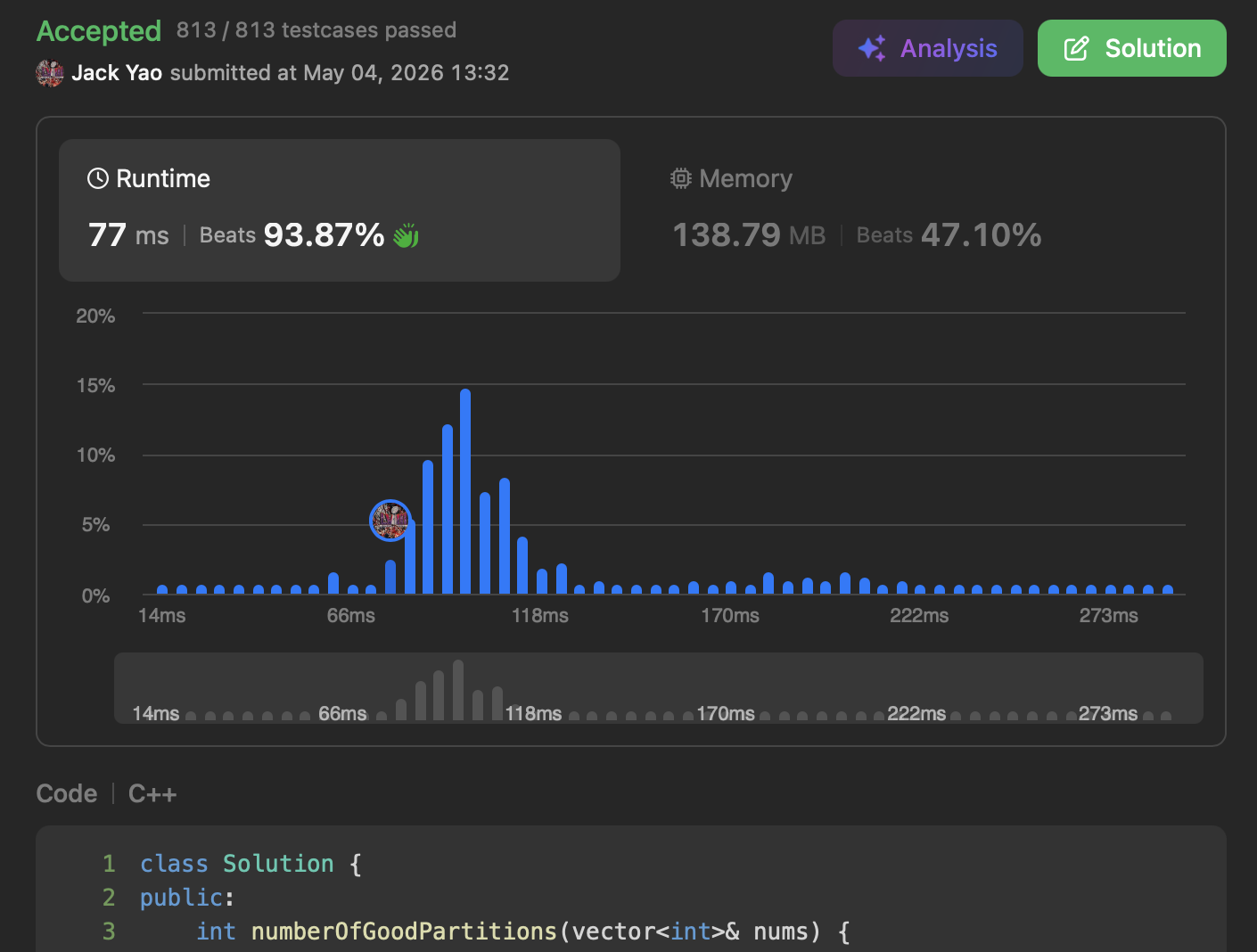 Hash map stores each number's last occurrence index. Space complexity .
Modular exponentiation is implemented iteratively. Space complexity .
Each index is scanned once by scanIdx, and once when building the hash map. Time complexity .
Modular exponentiation runs in , where is the total number of groups.
Since is at most , this is effectively .
Overall time and space complexity: both .
- C++
- Python
#include <unordered_map>
#include <vector>
using namespace std;

int countGoodPartitions(vector<int>& nums) {
    unordered_map<int, int> numsLastIndices; // Each num's last idx.

    for (int idx = 0; idx < nums.size(); idx++)
        numsLastIndices[nums[idx]] = idx;

    int windowsCount = 0; // Sliding window by two pointers.
    int scanIdx = 0, boundaryIdx = 0;

    while (boundaryIdx < nums.size()) {
        int num = nums[scanIdx];
        scanIdx++; // Already visited.

        if (boundaryIdx < numsLastIndices[num]) { // Num extends current window.
            boundaryIdx = numsLastIndices[num];
            continue;
        }

        if (scanIdx > boundaryIdx) {
            windowsCount++; // Current window is finalized.

            boundaryIdx++; // Search for another window, if possible.
        }
    }

    int goodPartitions = 1;

    int power = windowsCount - 1, modulo = pow(10, 9) + 7;

    while (power > 0) {
        goodPartitions *= 2;
        goodPartitions %= modulo; // Must prevent overflow.
        power--;
    }

    return goodPartitions;
}
def count_good_partitions(nums: list[int]) -> int:
    nums_last_indices: dict[int, int] = dict()  # Each num's last idx.

    for idx, num in enumerate(nums):
        nums_last_indices[num] = idx

    windows_count = 0  # Sliding window by two pointers.
    scan_idx, boundary_idx = 0, 0

    while boundary_idx < len(nums):
        num = nums[scan_idx]
        scan_idx += 1  # Already visited.

        if boundary_idx < nums_last_indices[num]:  # Num extends current window.
            boundary_idx = nums_last_indices[num]
            continue

        if scan_idx > boundary_idx:
            windows_count += 1  # Current window is finalized.

            boundary_idx += 1  # Search for another window, if possible.

    good_partitions = 1
    power = windows_count - 1
    base = 2  # Mod exp method speeds up quite some in Python.
    modulo = 10**9 + 7

    while power > 0:
        if power % 2 == 1:  # Power is odd: product times current base.
            good_partitions *= base
            good_partitions %= modulo

        base = (base * base) % modulo  # Square base and reduce power.
        power //= 2

    return good_partitions