2444. Bounded Subarrays
Count Subarrays With Fixed Bounds
Excellent problem to enhance sliding window technique.
Since We Need Both minK and maxK to Be Bounded
Each time we move window's right end rightIdx, first check whether
.
If not, falls outside valid range,
so no valid subarray with rightIdx as the right end can exist.
Directly reset window's left end leftIdx to rightIdx + 1,
and also reset both prevMinIdx and prevMaxIdx to -1,
since we don't yet know whether contains elements equal to or .
As Long as Stay Fully In Bounds
We look within window for:
the most recent index where , and assign it to prevMinIdx;
the most recent index where , and assign it to prevMaxIdx.
Once both prevMinIdx and prevMaxIdx are not -1,
our window has just satisfied the problem's requirements.
Valid subarrays within this window must satisfy three conditions:
(1). Right end exactly at rightIdx
(2). Left end at least at leftIdx, while not exceeding right end
(3). Left end at most at min(prevMinIdx, prevMaxIdx)
(1) and (2) are intuitive. The key is where (3) comes from.
If some index in the window satisfies min(prevMinIdx, prevMaxIdx) ,
then can't contain both and .
Each bounded subarray is required to contain both and .
Therefore, number of valid subarrays in current window is:
min(prevMinIdx, prevMaxIdx) + 1 - leftIdx
Add to boundedSubarraysCount, which will be returned at the end.
- C++
- Python
#include <vector>
using namespace std;

long long countBoundedSubarrays(vector<int>& nums, int minK, int maxK) {
    long long boundedSubarraysCount = 0;

    int prevMinIdx = -1, prevMaxIdx = -1;

    int leftIdx = 0;
    for (int rightIdx = 0; rightIdx < nums.size(); rightIdx++) {
        int num = nums[rightIdx];

        if (num < minK || num > maxK) { // Reset.
            prevMinIdx = -1, prevMaxIdx = -1;
            leftIdx = rightIdx + 1;
            continue;
        }

        if (num == maxK)
            prevMaxIdx = rightIdx;
        if (num == minK)
            prevMinIdx = rightIdx;

        if (min(prevMinIdx, prevMaxIdx) >= 0)
            boundedSubarraysCount += min(prevMinIdx, prevMaxIdx) + 1 - leftIdx;
    }

    return boundedSubarraysCount;
}
def count_bounded_subarrays(nums: list[int], min_k: int, max_k: int):
    bounded_subarrays_count = 0

    prev_min_idx, prev_max_idx = -1, -1

    left_idx = 0
    for right_idx, num in enumerate(nums):
        if num < min_k or num > max_k:  # Reset.
            prev_min_idx, prev_max_idx = -1, -1
            left_idx = right_idx + 1
            continue

        if num == max_k:
            prev_max_idx = right_idx
        if num == min_k:
            prev_min_idx = right_idx

        if min(prev_min_idx, prev_max_idx) >= 0:
            bounded_subarrays_count += min(prev_min_idx, prev_max_idx) + 1 - left_idx

    return bounded_subarrays_count
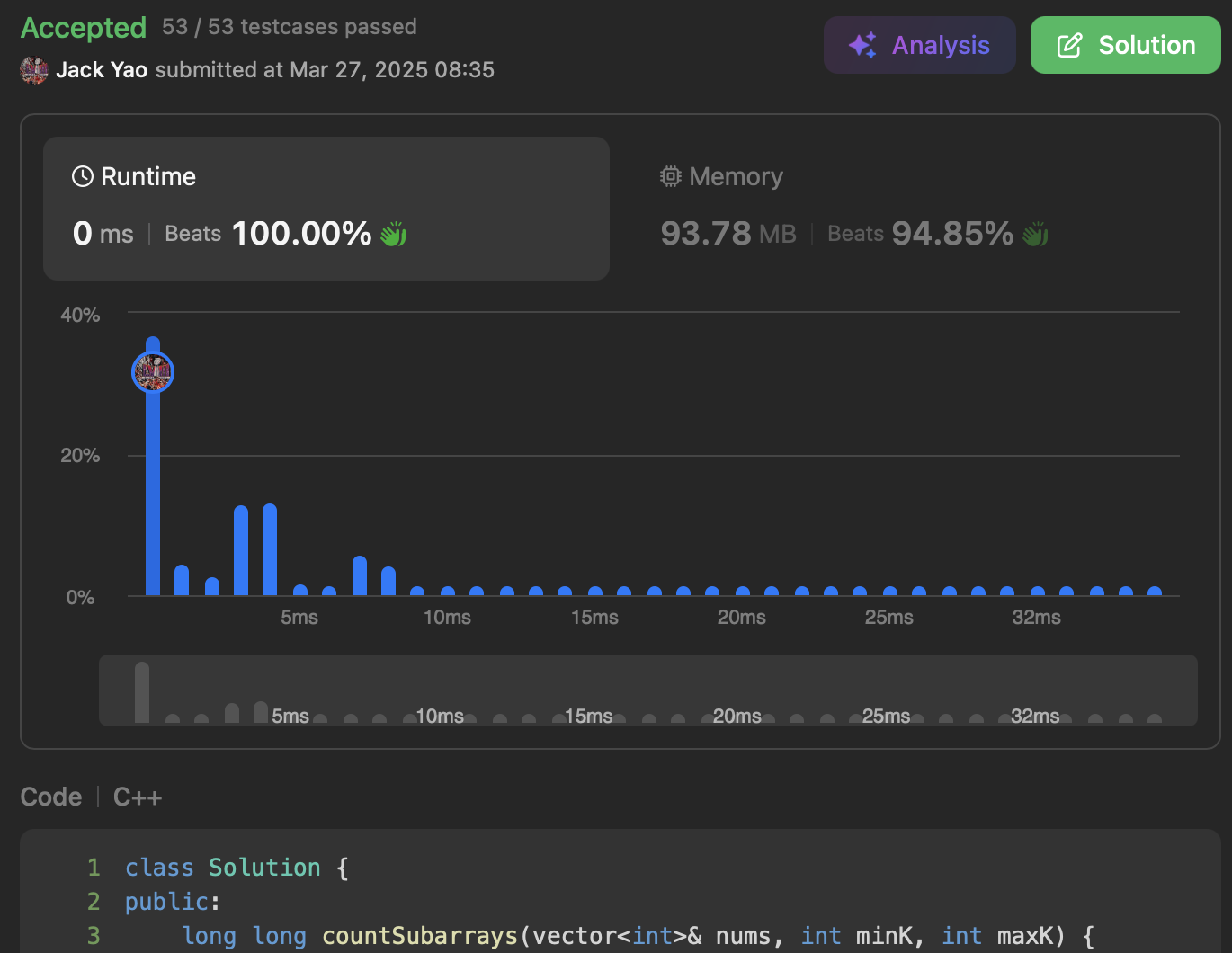 Time complexity is where is input array length.
Space is : just four pointers and
Time complexity is where is input array length.
Space is : just four pointers and boundedSubarraysCount to track total.